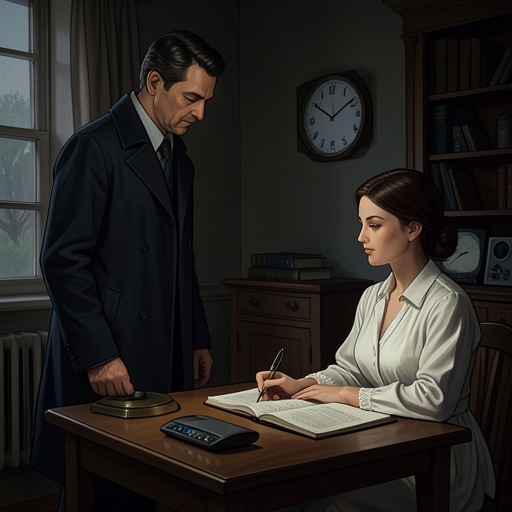
East Area Rapist attack in Danville
I'll Be Gone in the DarkThe East Area Rapist attack in Danville centered on Esther McDonald, who was alone in her home when the intruder entered and went directly to her bedroom. The investigation that followed treated the attack not as an isolated encounter but as part of a pattern of neighborhood surveillance: investigators and tracking dogs pieced together a route through fences and yards toward the railroad corridor. The house and its surroundings—the closed interior doors, an empty property next door, a nearby field and school, and the abandoned rail right-of-way—became evidence of how the attacker selected and moved through a place.
Setting and Approach
At the time of the attack, a six-foot wooden fence stood near abandoned railroad tracks east of Danville. Large trees concealed the fence, which buckled under the weight of someone climbing over it. The surrounding landscape offered several connected spaces: yards divided by fences, a rail corridor, and residential streets. A large open field and a school were across the street, while the neighboring house stood empty and was posted for lease. These conditions did not establish why the East Area Rapist chose this particular home, but they formed the setting through which investigators later interpreted his approach and departure.
Inside, the intruder bypassed rooms with closed doors and went directly to the master bedroom in the northwest corner of the house. Esther was sleeping alone. The account places him in the doorway, facing the bed from about ten feet away, before he woke her and attacked. The narrative identifies her as Esther McDonald and situates her life before the assault: she was thirty, had married at nineteen, and had spent a decade in a marriage that ended without children. She and a girlfriend had moved from a cold Midwestern state to San Francisco, drawn by the prospect of a sunnier future. That biographical context restores an individual history to a case otherwise reconstructed through the offender’s route and the investigators’ evidence.
The Scene and the Search
The first deputies alerted by dispatch arrived at 5:19 a.m. The scene held signs of deliberate preparation and interference: knotted white shoelaces, torn strips of orange towel, and cut phone lines. The house was cold because the thermostat had been turned off; the radio had also been switched off, apparently to improve the intruder’s ability to hear. These details gave investigators concrete features to examine while they tried to distinguish the attacker’s movements from the ordinary layout of the home.
Crime-scene investigator Larry Crompton focused on the conditions around the house as well as those inside it. A Realtor’s sign stood in the front yard, the property next door was vacant, and railroad tracks ran behind the home. Together, these observations suggested a setting with limited neighboring occupancy and a route away from the house. The account connects those features to the East Area Rapist’s recurring interest in particular environments, while stopping short of treating any one feature as proof of motive.
Three bloodhounds were brought to the scene. Pita was the first to work: she left through the back patio, moved toward the southwest corner of the yard, and strained toward the fence. Her handler and the officers took her around the yard and out toward the abandoned tracks. Pita stopped about half a mile from the house, at the point where the tracks met a residential street. Betsey and Eli were also used. Their handlers agreed on several conclusions, while noting that wind and the passage of time could alter scent trails. The dogs’ movements suggested that the attacker had spent considerable time in the area, crossing fences and moving through side yards before entering the victim’s backyard from the north-side fence. The interpreted exit ran over the southwest corner of the rear fence and south along the tracks, where he likely entered a vehicle at the cross street.
Neighborhood Surveillance and Escape
The dog trail gave physical form to a broader investigative picture of the East Area Rapist’s method. Police reports described prowling and illegal entries in homes around intended victims, small items disappearing, and a rise in hang-up calls within a few blocks shortly before attacks. The pattern suggested reconnaissance: the attacker studied a neighborhood, identified multiple possible victims, and learned something about when residents were home. This wider account helps explain why investigators read the dogs’ repeated turns through yards and along fences as evidence of time spent scouting rather than as an incidental route.
The Danville setting also matched a recurring preference for single-story houses. Paul Holes later explained that a single-story home could be observed from its windows and approached through yards without the visibility a second floor might provide. The book’s account further notes that the East Area Rapist often chose homes near open space and typically not at the very corner of a block. These are presented as patterns drawn from the cases, not as a complete explanation of this attack. At the Danville scene, the field, vacant neighboring house, trees, fences, and rail corridor supplied investigators with specific circumstances to compare against that wider pattern.
The Iron Horse Regional Trail follows the former Southern Pacific Railroad right-of-way through central Contra Costa. Paul Holes visited the residential street beside it, where agave plants shielded the back of the fence and made it difficult to approach closely. The hounds’ inferred escape route ended at the corner of the victim’s yard, and the nearby street offered a plausible point at which the attacker could have reached a vehicle. The trail and rail corridor thus served two roles in the investigation: they were features of the local landscape and a possible link between the concealed approach and the escape from the scene.
Significance and Wider Context
The investigation’s reconstruction made the attack legible through small, separate clues: the fence’s position and damage, the victim’s house layout, the disconnected phone line, the switched-off thermostat and radio, and the dogs’ route across the property. No single detail supplied the whole account. The route emerged from combining physical observations with the handlers’ agreement about the dogs’ behavior, while retaining the stated uncertainty that scent conditions can change. That distinction matters: the investigators could infer prolonged prowling and a likely vehicle pickup without claiming certainty about every movement.
The attack also belongs to a larger shift in public awareness surrounding the East Area Rapist cases. Early in the Sacramento attacks, authorities kept details from the press in hopes of containing the offender’s movement, while rumors filled the resulting information vacuum. As coverage became public, fear increasingly shaped how residents interpreted nighttime sounds and suspicious activity. In later accounts, some neighbors described retreating indoors rather than calling police. This community history does not establish that those responses caused or enabled the Danville attack; it shows the broader social landscape in which the crimes were understood. The Danville investigation, by contrast, narrowed attention to a specific house and a traceable path, turning the surrounding geography into evidence of deliberate surveillance and escape.